
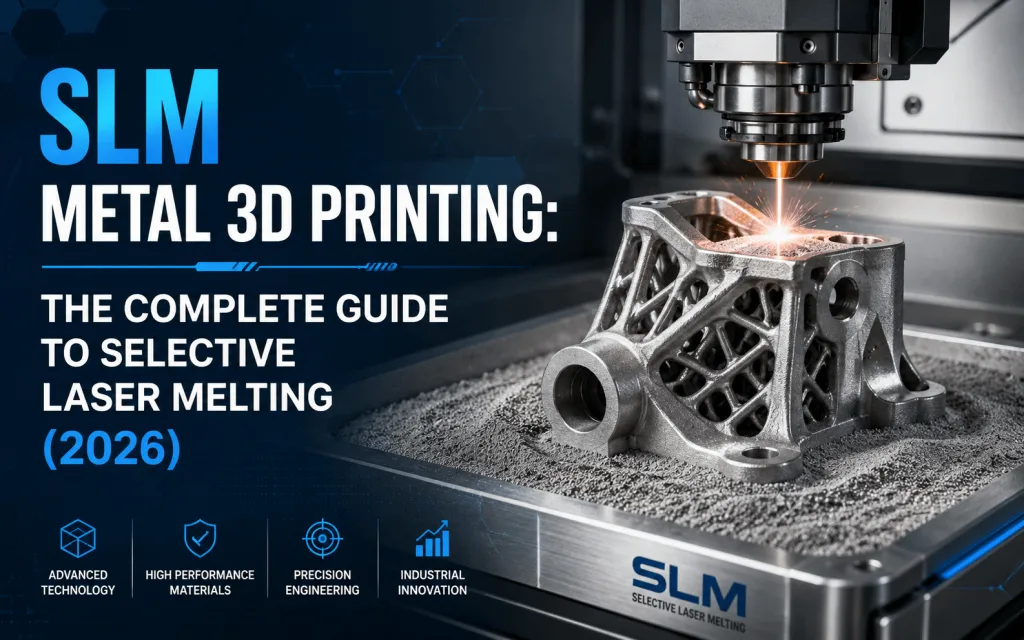
SLM Metal 3D Printing: The Complete Guide to Selective Laser Melting (2026)
Selective Laser Melting (SLM) is the leading metal additive manufacturing process for producing fully dense, end-use metal parts directly from a CAD file. Using a high-power fiber laser to fully melt fine metal powder layer by layer, SLM delivers parts with mechanical properties comparable to wrought or cast equivalents — in geometries that are impossible to make with CNC machining or casting.
This guide covers everything an engineer or buyer needs to make informed decisions about SLM: how the process works, available materials, design rules, tolerances, post-processing, costs, and where SLM beats — or loses to — alternative manufacturing methods.
Key takeaways
- What it is: A powder bed fusion process (classified as PBF-LB/M under ISO/ASTM 52900) that fully melts metal powder with a fiber laser.
- Part density: Typically >99.5%, with HIP raising this to >99.95%.
- Layer thickness: 20–60 μm (most production uses 30–40 μm).
- Standard tolerance: ±0.1 mm or ±0.2% of nominal, whichever is greater.
- Materials: Stainless steels, tool steels, aluminum alloys, titanium alloys, nickel superalloys, cobalt-chrome, copper.
- Best for: Complex geometries, internal channels, lightweight lattices, design consolidation, small batches (1–500 parts).
- Not ideal for: Large parts (>500 × 500 × 500 mm), tight-tolerance mating surfaces without machining, high-volume production where casting wins on cost.
💡 Need a quote? Upload your CAD file to our instant quote tool — SLM parts start from $0.16/g in 316L stainless, with 24-hour expedited production available.
1. What is SLM (Selective Laser Melting)?
Selective Laser Melting is a metal 3D printing process in which a high-power fiber laser (typically 200–1,000 W) scans across a bed of fine metal powder, fully melting the particles along the cross-section of each layer. After one layer is built, the build plate lowers by 20–60 μm, a recoater spreads a fresh layer of powder, and the process repeats — typically for thousands of layers — until a complete metal part is produced.
The process takes place inside a sealed chamber under inert atmosphere (argon for reactive metals like titanium and aluminum; nitrogen for steels), keeping oxygen below 1,000 ppm to prevent oxidation and porosity.
SLM, DMLS, LaserCUSING — what’s the difference?
These names refer to essentially the same process under different trademarks:
| Trade name | Owner | Notes |
|---|---|---|
| SLM (Selective Laser Melting) | Originally SLM Solutions, now Nikon | Generic industry term |
| DMLS (Direct Metal Laser Sintering) | EOS | “Sintering” is a misnomer — the process fully melts |
| LaserCUSING | Concept Laser (GE Additive) | Identical mechanism |
| PBF-LB/M | ISO/ASTM 52900 | Official standardized term |
In practice, engineers and buyers use SLM and DMLS interchangeably. When you upload a file to FabNow3D, the part is produced on industrial PBF-LB/M systems regardless of which name the spec sheet uses.
2. How SLM works, step by step
A production SLM build cycle has nine distinct stages:
1. CAD preparation and slicing. The .STEP or .STL file is imported into build-preparation software (Materialise Magics, Autodesk Netfabb, EOSPRINT). Engineers orient the part for minimum support, fix mesh errors, and generate support structures.
2. Build nesting. Multiple parts are arranged on the virtual build plate to maximize utilization — this is the single biggest factor in per-part cost.
3. Powder loading. The hopper is loaded with virgin or recycled metal powder (typically 15–45 μm particle size for SLM). Powder oxygen content is monitored.
4. Build plate preparation. A steel build plate is machined flat, leveled and pre-heated. Aluminum builds use a plate temperature of 150–200 °C; titanium and Inconel use 80–200 °C.
5. Recoating. A blade or roller spreads a layer of powder, typically 30 μm thick, across the build plate. Layer uniformity is critical — uneven powder leads to porosity defects.
6. Laser scanning. A galvo-scanner directs the fiber laser across the cross-section, fully melting the powder along the toolpath. Modern multi-laser systems (2, 4, or 12 lasers) scan in parallel for higher throughput.
7. Layer descent and repeat. The build plate drops by one layer thickness and steps 5–6 repeat. A typical 100 mm tall part requires 2,500–5,000 layers and 12–48 hours of build time.
8. Cool-down and depowdering. The chamber is purged and cooled. Loose powder is recovered (and recycled, with sieving and oxygen monitoring).
9. Stress relief. Before separation, parts are heat-treated while still attached to the build plate to relieve thermal residual stresses that build up during printing. Skipping this step leads to warpage when supports are cut.
After stress relief, parts are removed from the build plate (wire EDM or band saw), supports are removed, and finishing operations begin. See Section 7: Post-processing below.
3. SLM materials: mechanical properties at a glance
The table below summarizes typical as-built (or standard-heat-treated) mechanical properties of the most commonly specified SLM materials. Values are typical industry ranges; actual properties depend on build orientation, parameter set, and heat-treatment condition. All materials at FabNow3D are supplied with certificates of conformity per the relevant ASTM standard.
| Material | Standard | UTS (MPa) | Yield (MPa) | Elongation | Density | Typical applications |
|---|---|---|---|---|---|---|
| 316L stainless | ASTM F3184 | 540–680 | 470–530 | 30–50% | 7.99 g/cm³ | Marine, food, chemical, medical |
| 17-4 PH stainless | ASTM F3301 | 1100+ (H900) | 1050+ | 10–15% | 7.78 g/cm³ | Tooling, fixtures, aerospace brackets |
| AlSi10Mg | ASTM F3318 | 360–460 | 230–270 | 6–10% | 2.67 g/cm³ | Lightweight brackets, heat sinks, drone parts |
| 6061-RAM2 aluminum | (mfr. spec) | 350+ (T6) | 320+ | 12% | 2.70 g/cm³ | Structural lightweighting |
| Ti6Al4V (Ti64) | ASTM F2924 | 1000–1200 | 950–1100 | 10–15% | 4.43 g/cm³ | Aerospace, medical implants, motorsport |
| Inconel 718 | ASTM F3055 | 1240+ (aged) | 1100+ | 10–20% | 8.19 g/cm³ | Aerospace hot section, energy, downhole |
| Inconel 625 | ASTM F3056 | 950+ | 700+ | 35–40% | 8.44 g/cm³ | Marine, chemical, exhaust |
| MS1 maraging steel | (mfr. spec) | 1900+ (aged) | 1800+ | 5–10% | 8.0 g/cm³ | Injection-mold inserts (conformal cooling) |
| CoCrMo | ASTM F3001 | 1100+ | 900+ | 12–20% | 8.4 g/cm³ | Dental, orthopedic, hot gas ducts |
| CuCrZr copper | (mfr. spec) | 400+ | 300+ | 20% | 8.9 g/cm³ | Heat exchangers, induction coils, rocket combustion |
How to choose a material
A simple three-question filter:
- What environment will it see? Corrosive → 316L or Inconel 625. High temperature (>500 °C) → Inconel 718, CoCr. Marine → 316L, Inconel 625.
- How critical is weight? Aerospace structural → Ti6Al4V or AlSi10Mg. Cost-sensitive lightweight → AlSi10Mg.
- Does it need to be the cheapest functional metal? → 316L. It’s the most economical SLM material and covers most applications.
For application-specific advice, upload your model and add a note on the operating environment — our engineers will recommend a material and process route within one business day.
4. Advantages of SLM metal 3D printing
Geometric freedom. SLM produces internal channels, conformal cooling passages, undercuts, and topology-optimized geometries that cannot be machined or cast. This is the single most-cited reason engineers choose SLM.
Fully dense parts. Achieved density of >99.5% in standard parameter sets and >99.95% after HIP makes SLM parts suitable for pressure-bearing, fatigue-critical and structural applications.
No hard tooling. A first SLM part costs the same as the hundredth. This makes SLM the cheapest route for quantities of 1–50 metal parts in complex geometry.
Design consolidation. A common case study: GE’s LEAP engine fuel nozzle replaced an assembly of 20 brazed components with a single SLM part — 25% lighter and 5× more durable in service. The same principle applies to manifolds, brackets, and heat exchangers.
Material range. SLM supports more metals than any other AM process, including high-temperature superalloys (Inconel) and reactive metals (titanium, aluminum).
Small-batch economics. For 1–500 complex parts, SLM is typically faster and cheaper than CNC + assembly or low-volume casting with tooling.
5. Limitations of SLM (be honest about these)
Build volume. Most production SLM machines have build envelopes between 250 × 250 × 325 mm and 500 × 500 × 500 mm. Parts larger than this require splitting and joining.
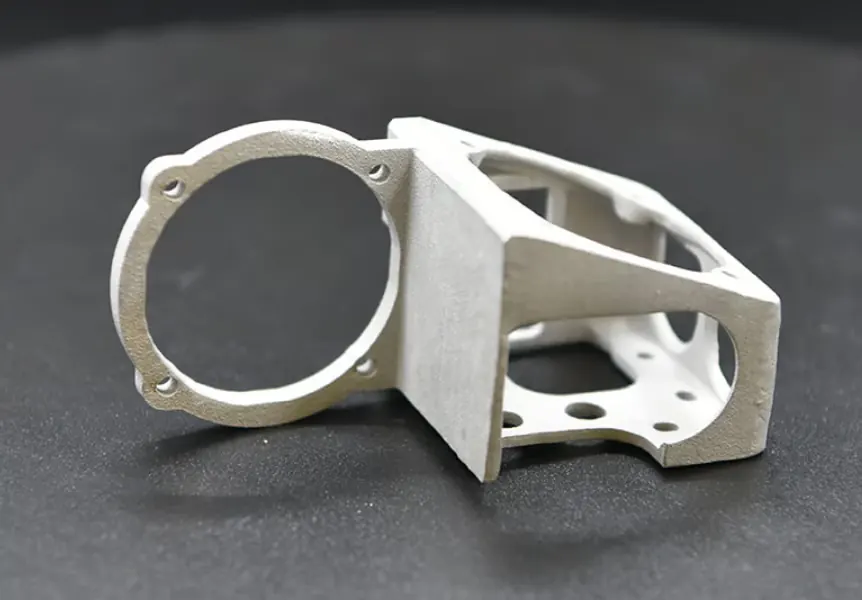
Surface roughness as-built. As-printed Ra is typically 6–15 μm on vertical walls and worse on down-facing (overhang) surfaces. Critical mating faces almost always require machining.
Support structures. Overhangs below 45° from horizontal require support structures, which add build time, powder cost, and post-processing labor.
Anisotropy. Mechanical properties vary 5–15% between Z (build direction) and XY directions. Most data sheets quote XY values; design with the lower number for safety-critical parts.
Residual stress. Thermal gradients during printing create internal stresses. Without proper stress-relief heat treatment, parts can warp, crack, or distort during support removal.
Cost per gram. SLM parts cost $0.16–$3.00 per gram of material in production. For high-volume simple geometry, investment casting or forging will always be cheaper.
Lead time for finishing. While the print itself can finish in 24 hours, full post-processing (stress relief, support removal, HIP, machining critical surfaces, finish) typically takes 5–8 business days end-to-end.
6. Design for SLM (DfAM): the rules that matter
Following these rules prevents 80% of design-related failures and rework. We strongly recommend reviewing them before sending a file for quotation.
Minimum feature dimensions
| Feature | Minimum |
|---|---|
| Wall thickness | 0.4–0.5 mm (1.0 mm for structural) |
| Pin / standoff diameter | 0.5 mm |
| Hole diameter (vertical axis) | 0.5 mm |
| Hole diameter (horizontal axis) | 1.0 mm (or design as teardrop) |
| Embossed text height | 0.5 mm |
| Engraved text depth | 0.4 mm |
| Gap between parts | 0.3 mm |
Overhangs and supports
- 45° rule: surfaces angled ≥45° from horizontal are self-supporting.
- Bridges: unsupported horizontal spans up to 1–2 mm are usually OK; beyond this, expect drooping.
- Holes: round horizontal holes >8 mm diameter sag at the top — redesign as a teardrop or diamond to avoid supports.
Internal channels and trapped powder
Internal passages must have escape holes ≥3 mm diameter at both ends so loose powder can be removed. Trapped powder adds weight and may compromise fatigue performance. For conformal cooling channels in mold inserts, design with smooth curves (no sharp 90° bends) for both flow performance and depowdering.
Orientation effects
Build orientation affects strength, surface finish, support volume, and cost simultaneously:
- Vertical orientation: best surface finish on side walls, weakest in Z direction (build axis), often the cheapest because of low cross-section per layer.
- Horizontal orientation: highest strength along the long axis, more supports needed, more material consumed.
- 45° tilt: a frequent compromise that balances support, strength and finish.
Specify a preferred orientation in your purchase notes if a particular face or feature is critical.
Lattices and topology optimization
SLM is one of the only processes that can build true lattice structures. Typical strut diameters range from 0.3 to 2.0 mm. For weight-critical aerospace and motorsport parts, topology-optimized + lattice-infilled designs can reduce mass by 30–60% versus a solid CNC-machined equivalent.
7. Post-processing for SLM parts
Almost every SLM part undergoes some post-processing. The full sequence depends on application; here is the standard path for an aerospace or industrial part:
1. Stress relief. Performed before the part is removed from the build plate. Temperatures vary by material (e.g., Ti6Al4V: 650 °C for 2 hr; 316L: 600 °C for 2 hr).
2. Build plate separation. Wire EDM (preferred — clean cut, no distortion) or band saw.
3. Support removal. Manual breaking, plier removal, or machining. Difficult internal supports may require EDM.
4. Heat treatment. Material-specific:
- Ti6Al4V: solution treat + age, or hot isostatic press
- 17-4 PH: solution treat → H900 / H1025 / H1150 aging
- Inconel 718: solution + double aging
- AlSi10Mg: T6 if higher strength is needed (note: drops elongation)
5. HIP (Hot Isostatic Pressing). Combined heat + 100–200 MPa argon pressure closes internal porosity. Required for fatigue-critical aerospace and medical parts. Typically improves fatigue life by 3–10×.
6. Surface finishing options:
| Method | Achieved Ra | Visual | Best for |
|---|---|---|---|
| As-built | 6–15 μm | Matte, grainy | Non-cosmetic functional parts |
| Bead blasting | 4–8 μm | Uniform matte | Standard production finish |
| Tumbling / vibratory | 2–5 μm | Smooth matte | Small/medium batches |
| Manual polishing | 0.4–1 μm | Satin to mirror | Visible cosmetic surfaces |
| Electropolishing | 0.2–0.8 μm | Bright mirror | Stainless, medical |
| CNC machining (critical faces) | 0.4–1.6 μm | Machined | Sealing surfaces, threads, bearings |
7. Functional coatings. Anodizing (aluminum), PVD/DLC, electroless nickel plating, passivation (stainless), painting/powder coat.
8. Inspection. CMM, 3D scan, dye penetrant (NDT), X-ray CT for internal porosity verification.
For a full breakdown of available finishes and what they look like in practice, see our post-processing services page.
8. SLM vs alternative manufacturing processes
| Process | Density | Tolerance | Cost (per part, low qty) | Best for | Worst for |
|---|---|---|---|---|---|
| SLM (PBF-LB/M) | >99.5% | ±0.1 mm | $$$ | Complex geometries, internal features, lattices, batches 1–500 | Simple solid parts, very large parts |
| EBM (electron beam melt) | >99.5% | ±0.2 mm | $$$$ | Ti aerospace, large titanium implants | Aluminum, steels, fine features |
| Metal binder jetting | ~98% (sintered) | ±0.3 mm | $$ | High-volume small parts, complex geometry | Tight-tolerance, structural, large parts |
| Bound metal extrusion (BMD) | ~96% (sintered) | ±0.5 mm | $ | Prototypes, jigs in stainless | Production, fatigue-critical |
| Investment casting | ~99% | ±0.5% | $ at volume | High volume of similar complex parts | One-offs (tooling cost) |
| CNC machining | 100% (wrought) | ±0.025 mm | $$ | Tight tolerances, simple geometries, large parts | Complex internal features, lattices |
| Sheet metal + welding | 100% | ±0.5 mm | $ | Flat / formed geometries | 3D complex geometries |
When to choose SLM specifically
Choose SLM if two or more of these apply:
- The part has internal channels that machining can’t reach
- The part is topology-optimized or has lattice infill
- You need 1–500 parts and tooling cost would dominate
- The geometry would otherwise require a multi-component welded assembly
- You’re prototyping a part that will eventually be cast or forged and need a functional metal sample now
If your part is a simple solid prism with tight tolerances on every face, CNC machining will be faster and cheaper — and we offer that too. See our CNC machining service.
9. What does SLM 3D printing cost?
SLM part pricing is driven by, in order of impact:
1. Machine time (build height). Layer count drives time. A part 100 mm tall takes 2× the build time of the same part 50 mm tall, regardless of cross-section. Lowest-cost orientation is usually the shortest Z-height.
2. Material consumed (part + supports + powder loss). Material cost ranges from $0.16/g (316L) to $2.56/g (titanium) to $2.08/g (Inconel 718).
3. Build plate utilization. A single small part on a big plate pays for the full build. Nesting multiple parts together spreads the fixed cost.
4. Post-processing. Stress relief (~$50–150), HIP (~$150–500 per batch), surface finishing ($20–500), critical-feature machining ($50–300 per feature).
5. Inspection. Standard dimensional check is included; CMM, CT scan and material certificates add $50–500.
Indicative starting prices at FabNow3D
| Material | Process | From (per g) | Lead time |
|---|---|---|---|
| 316L stainless | SLM | $0.42 | 5–7 days |
| 17-4 PH | SLM | $0.50 | 5–7 days |
| AlSi10Mg | SLM | $0.77 | 5–7 days |
| 6061 aluminum | SLM | $0.92 | 5–7 days |
| Inconel 718 | SLM | $2.08 | 6–8 days |
| Ti6Al4V | SLM | $2.56 | 6–8 days |
See full transparent pricing or get an exact instant quote by uploading your file.
Five practical ways to reduce SLM cost
- Hollow large solids. Add internal lattice or thin walls with 3 mm depowder holes.
- Reduce part height. Orient the longest dimension in XY, not Z.
- Specify “machine only critical surfaces.” Avoid blanket finishing requirements.
- Choose the right alloy. 316L is 6× cheaper than Inconel; AlSi10Mg is 3× cheaper than Ti64.
- Batch your orders. Combining 5 designs into one build cycle can reduce per-part cost by 20–40%.
10. How to choose an SLM supplier (and what we offer)
Not all SLM is equal. Build parameters, powder quality, post-processing capability and quality systems vary widely between suppliers. When evaluating any provider — including us — these are the right questions to ask:
Process control
- What machines do you operate? (Industry-standard platforms include EOS, SLM Solutions/Nikon, Renishaw, EPlus3D, BLT, Farsoon.)
- What’s your powder reuse and sieving policy?
- Do you monitor oxygen content during builds?
Quality systems
- ISO 9001 (general)
- AS9100 (aerospace)
- ISO 13485 (medical devices)
- Material certificates per ASTM standards
Capabilities
- Build envelope (single-piece maximum dimensions)
- Post-processing in-house vs outsourced
- HIP, CNC finishing, NDT and CT inspection availability
- Material range
Commercial
- Transparent, public pricing
- Lead time guarantees
- IP protection (NDA, file handling policy)
- Sample/first-article inspection support
Why customers choose FabNow3D
- 500+ industrial printers across 5 processes, with 6 metals in production daily.
- Public, transparent pricing — no quote runaround.
- 24-hour expedited builds available for time-critical work.
- Strict NDA and file confidentiality — every CAD file is treated as proprietary.
- >95% on-time delivery; <0.5% complaint rate across 100,000+ parts produced annually.
- Shipping to 100+ countries with full DHL Express integration and complete duties documentation.
SLM 3D printing — frequently asked questions
Is SLM the same as DMLS?
Functionally, yes. SLM and DMLS both fully melt metal powder with a fiber laser in a powder bed. “DMLS” is EOS’s trade name; “SLM” is the generic industry term standardized as PBF-LB/M in ISO/ASTM 52900. A part produced on either system to the same parameter set has the same properties.
What’s the strongest material available in SLM?
By tensile strength, MS1 maraging steel (>1900 MPa aged) is the strongest standard SLM material. By strength-to-weight ratio, Ti6Al4V is unmatched. For high-temperature strength, Inconel 718 maintains usable properties to 650 °C.
Can SLM parts replace machined or cast parts in service?
Yes, in most cases. After standard heat treatment (and HIP for fatigue-critical applications), SLM parts meet or exceed the static and dynamic mechanical properties of equivalent wrought or cast components. SLM parts are flying on the GE LEAP engine, Boeing 787, and SpaceX SuperDraco — none of which tolerate sub-standard parts.
What’s the largest part you can SLM print?
Most production machines handle parts up to 500 × 500 × 500 mm. Larger structures (up to 1 m) are available on specialty systems. Parts above this size are usually split, printed in sections, and joined by welding or fasteners.
How accurate is SLM?
Standard achievable tolerance is ±0.1 mm or ±0.2% of nominal dimension, whichever is greater. With post-process CNC machining on critical features, tolerances of ±0.025 mm (IT7) are routinely achieved.
Can I get an SLM part in a day?
The print itself can be completed in 24 hours for small parts. Full delivery including stress relief and basic finishing is typically 5–7 business days. For genuinely time-critical projects, FabNow3D offers expedited builds — contact us before placing the order so we can reserve machine time.
Is SLM safe for medical implants?
Yes — Ti6Al4V ELI (Extra Low Interstitial) and CoCrMo per ASTM F3001 are widely used for implants. The relevant quality system is ISO 13485, and FDA / CE marking is required for finished medical devices. We can supply implant-grade material with full traceability; certification of the finished device is the customer’s responsibility.
How does SLM compare to binder jetting for metal?
Binder jetting is cheaper per part at high volume but produces lower-density (~98%) parts that need a separate sintering step. SLM produces fully dense parts in a single process. Choose binder jetting for high-volume small parts where slight porosity is acceptable; choose SLM for structural, pressure-bearing, or fatigue-critical applications.
Do I need to design supports myself?
No. Support generation is part of our standard preparation. Send a clean .STEP or .STL file, and our engineers handle orientation and support strategy. If you have a specific requirement — preferred face up, no supports on a cosmetic surface — tell us in the order notes.
What file formats do you accept?
For SLM, we recommend .STEP / .STP (preferred) because it preserves design intent and tolerances. .STL and .OBJ are also accepted but may need repair if the mesh is broken. Send native CAD (SOLIDWORKS, Fusion, Creo) only if there’s no other option — we’ll convert it.
Ready to start your SLM project?
If you’ve made it this far, you already know more about SLM than 95% of the engineers who specify it. The fastest way to apply that knowledge is to upload your file and see real numbers for your specific geometry.
Or, if you’d prefer to talk through process selection with one of our engineers before quoting, contact us — most enquiries get a same-day response.