
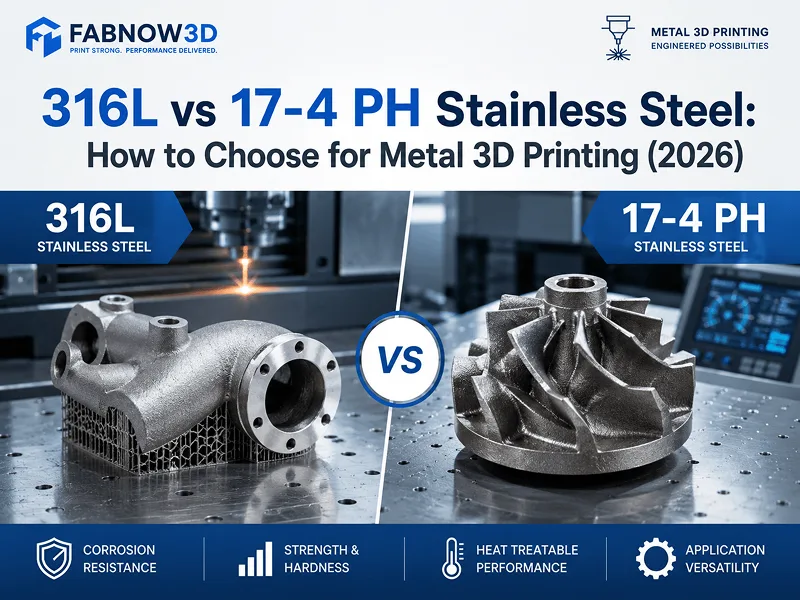
316L vs 17-4 PH Stainless Steel: How to Choose for Metal 3D Printing (2026)

Choose 316L when corrosion resistance and ductility matter most; choose 17-4 PH when you need high strength and hardness. These are the two most-specified stainless steels in SLM metal 3D printing, and they sit at opposite ends of a clear trade-off: 316L is the corrosion-and-toughness alloy, 17-4 PH is the strength-and-hardness alloy.
This guide breaks down exactly when to pick each — across mechanical properties, corrosion resistance, heat treatment, cost, and real application fit — so you can specify with confidence.
Quick answer
| If your priority is… | Choose |
|---|---|
| Maximum corrosion resistance | 316L |
| Marine, chemical, or medical environment | 316L |
| Ductility and impact toughness | 316L |
| Welding without post-treatment | 316L |
| Maximum strength and hardness | 17-4 PH |
| Wear resistance | 17-4 PH |
| Structural / load-bearing parts | 17-4 PH |
| Tooling, fixtures, shafts | 17-4 PH |
| Lowest cost per part | 316L (slightly) |
💡 Both alloys are in daily production at FabNow3D, starting from $0.42/g (316L) and $0.50/g (17-4 PH). Upload your file for an instant quote in either material.
1. The fundamental difference
The two alloys are different types of stainless steel, and that’s the root of every difference that follows.
316L is an austenitic stainless steel. Its strength comes from its alloy chemistry (high chromium, nickel, and molybdenum). It cannot be hardened by heat treatment — it’s used in the as-built or solution-annealed condition. The “L” means low carbon, which improves corrosion resistance and weldability.
17-4 PH is a martensitic precipitation-hardening stainless steel. The “PH” stands for precipitation hardening. Its strength comes from heat treatment: an aging process precipitates copper-rich particles throughout the microstructure, dramatically increasing strength and hardness. It can be tuned to different strength/ductility balances by choosing the aging temperature.
In short: 316L resists the environment; 17-4 PH resists the load.
2. Mechanical properties compared
Values below are typical for SLM-produced parts after standard heat treatment. Actual values depend on build orientation, parameters, and heat-treatment condition. FabNow3D supplies material certificates per the relevant ASTM standard with every order.
| Property | 316L | 17-4 PH (H900) | 17-4 PH (H1025) |
|---|---|---|---|
| Standard | ASTM F3184 | ASTM F3301 | ASTM F3301 |
| Ultimate tensile strength | 540–680 MPa | 1300–1400 MPa | 1070–1150 MPa |
| Yield strength | 470–530 MPa | 1170–1250 MPa | 1000–1090 MPa |
| Elongation at break | 30–50% | 8–12% | 12–16% |
| Hardness | 85–95 HRB (~20 HRC) | 40–44 HRC | 35–38 HRC |
| Density | 7.99 g/cm³ | 7.78 g/cm³ | 7.78 g/cm³ |
| Young’s modulus | ~190 GPa | ~197 GPa | ~197 GPa |
| Max service temp | ~800 °C (oxidation) | ~300 °C | ~300 °C |
What the numbers tell you
- 17-4 PH is roughly 2–2.5× stronger than 316L in its hardened condition.
- 316L is 3–5× more ductile (elongation), making it far more forgiving of impact and deformation.
- 17-4 PH is much harder, giving it superior wear resistance.
- 316L tolerates higher temperatures before losing corrosion resistance, but 17-4 PH loses its temper above ~300 °C.
3. Corrosion resistance compared
This is where 316L pulls clearly ahead.
316L contains 2–3% molybdenum, which dramatically improves resistance to pitting and crevice corrosion — especially against chlorides (seawater, de-icing salt, bleach, body fluids). It’s the default stainless for:
- Marine hardware
- Chemical processing
- Food and beverage equipment
- Medical and surgical devices (non-load-bearing)
- Pharmaceutical equipment
17-4 PH has good corrosion resistance — better than standard 410 or 420 martensitic steels — but not as good as 316L, mainly because it has no molybdenum and lower chromium in the matrix after aging. It performs well in mild atmospheric and freshwater environments but is more susceptible to pitting in chloride-rich conditions.
Practical guidance:
| Environment | 316L | 17-4 PH |
|---|---|---|
| Seawater / marine | ✅ Excellent | ⚠️ Marginal |
| Chloride / bleach | ✅ Excellent | ❌ Poor |
| Freshwater | ✅ Excellent | ✅ Good |
| Atmospheric / indoor | ✅ Excellent | ✅ Good |
| Mild acids | ✅ Good | ⚠️ Fair |
| Food contact | ✅ Excellent | ⚠️ Check regulations |
If the part will ever see salt water or chlorides, default to 316L unless strength requirements force 17-4 PH — in which case consider a protective coating or passivation.
4. Heat treatment: the 17-4 PH advantage (and complication)
This is the single biggest operational difference between the two alloys.
316L — simple
316L is typically used as-built or after a solution anneal (~1050 °C, then rapid cool) to relieve stress and homogenize the microstructure. There’s no hardening step. Simple, predictable, one path.
17-4 PH — tunable, but requires a decision
17-4 PH must be heat treated to reach its properties, and you choose the aging condition to balance strength against ductility. The common conditions:
| Condition | Aging temp | Strength | Ductility | Use when |
|---|---|---|---|---|
| H900 | 482 °C | Highest | Lowest | Maximum hardness/strength needed |
| H1025 | 552 °C | High | Moderate | Balanced strength + toughness |
| H1075 | 579 °C | Medium-high | Good | General purpose |
| H1150 | 621 °C | Moderate | Highest | Toughness/impact priority |
The naming convention: the number is the aging temperature in °F (H900 = aged at 900 °F = 482 °C). Higher number = higher temperature = lower strength but higher toughness.
For most structural applications, H900 (max strength) or H1025 (balanced) are the standard choices. Tell us the condition you need when ordering, or describe the application and we’ll recommend one.
⚠️ AM-specific note: SLM-produced 17-4 PH should typically undergo a solution treatment before aging because the as-built microstructure differs from wrought material (it can retain austenite). At FabNow3D, our standard 17-4 PH route includes solution treatment + the specified aging condition for consistent, certified properties.
5. Cost comparison
The two alloys are close in price, but there are second-order cost effects.
| Cost factor | 316L | 17-4 PH |
|---|---|---|
| Powder cost (per g) | from $0.42 | from $0.50 |
| Heat treatment | Optional (stress relief only) | Required (solution + age) |
| Machinability (post-process) | Easier (softer) | Harder (especially after aging) |
| Net relative cost | Baseline | ~10–25% higher |
Why 17-4 PH costs more:
- Slightly higher powder cost
- Mandatory heat-treatment cycle (solution + aging)
- Harder to machine after aging, so any post-machining costs more — best practice is to machine before final aging where possible
For cost-sensitive parts where strength isn’t the deciding factor, 316L is the economical default.
6. Printability and surface finish
Both alloys print well on SLM systems, with minor differences:
- 316L is one of the most forgiving SLM materials — stable melt pool, low crack sensitivity, excellent density (>99.5% routinely). Good as-built surface finish.
- 17-4 PH also prints reliably but is slightly more sensitive to parameter drift; residual stress management matters more because of its higher strength. Surface finish is comparable.
Neither alloy presents the printability challenges of, say, aluminum or copper. Both achieve fine feature resolution and are suitable for the full range of DfAM geometries — thin walls, lattices, internal channels.
7. Application fit: who chooses what
Typical 316L applications
- Marine: pump components, fittings, brackets exposed to seawater
- Medical: surgical instrument bodies, non-load-bearing implant components, jigs
- Food & beverage: nozzles, manifolds, contact parts
- Chemical: valve bodies, fluid-handling components
- Heat exchangers: where corrosion resistance beats strength
- Consumer: visible parts where a corrosion-proof finish matters
Typical 17-4 PH applications
- Tooling: jigs, fixtures, gauges that take repeated load
- Aerospace: structural brackets, fittings (non-marine)
- Automotive / motorsport: suspension components, drivetrain brackets
- Shafts and couplings: where wear resistance matters
- Injection mold inserts: where strength is needed but conformal cooling isn’t (otherwise MS1 maraging)
- Industrial machinery: load-bearing structural parts
The decision in one sentence
If the part’s main enemy is the environment (corrosion, chemicals, salt), choose 316L. If the part’s main enemy is the load (stress, wear, impact under high force), choose 17-4 PH.
8. When neither is the right answer
Sometimes the 316L-vs-17-4 PH question is the wrong question. Consider alternatives if:
- You need maximum strength (>1500 MPa) → MS1 maraging steel (up to 1900+ MPa)
- You need high-temperature strength (>300 °C) → Inconel 718 or Inconel 625
- You need both marine corrosion resistance AND high strength → consider Inconel 625 or a 316L part with a hardened coating
- You need the lightest possible part → Ti6Al4V (titanium) or AlSi10Mg (aluminum)
- You need maximum thermal conductivity → CuCrZr copper
Not sure? Describe your operating environment and load case when you upload your file and our engineers will recommend a material within one business day.
9. Side-by-side summary table
| Factor | 316L | 17-4 PH |
|---|---|---|
| Type | Austenitic | Martensitic (precipitation hardening) |
| Tensile strength | 540–680 MPa | up to 1400 MPa |
| Ductility | High (30–50%) | Low–moderate (8–16%) |
| Hardness | ~20 HRC | 35–44 HRC |
| Corrosion resistance | Excellent | Good (not for chlorides) |
| Heat treatment | Optional | Required (and tunable) |
| Max service temp | ~800 °C | ~300 °C |
| Machinability | Good | Harder after aging |
| Relative cost | Baseline | ~10–25% higher |
| Best for | Corrosion, ductility, marine, medical | Strength, hardness, wear, structural |
10. Why source your stainless SLM parts from FabNow3D
- Both alloys in daily production — 316L from $0.42/g, 17-4 PH from $0.50/g, with full ASTM material certificates.
- In-house heat treatment — including the full solution + aging cycle for 17-4 PH, with your specified condition (H900, H1025, H1075, or H1150).
- Hybrid finishing — SLM + CNC machining of critical features under one roof, so you can have a corrosion-resistant or high-strength part with precision-finished surfaces.
- Engineering support — tell us the application, get a material recommendation within one business day.
- Transparent pricing and global shipping — to 100+ countries with full duties documentation.
Get an instant quote → or talk to our engineering team about your material selection.
316L vs 17-4 PH — frequently asked questions
Is 17-4 PH stronger than 316L?
Yes, significantly. In its hardened condition (H900), 17-4 PH reaches 1300–1400 MPa tensile strength, roughly 2–2.5× that of 316L (540–680 MPa). However, 316L is far more ductile (30–50% elongation vs 8–12%), making it more impact-tolerant.
Which has better corrosion resistance, 316L or 17-4 PH?
316L has clearly better corrosion resistance, especially against chlorides and in marine environments, because it contains 2–3% molybdenum and higher matrix chromium. 17-4 PH has good general corrosion resistance but is more susceptible to pitting in salt-rich conditions.
Does 316L need heat treatment after 3D printing?
No, not for hardening — 316L cannot be hardened by heat treatment. It’s used as-built or after a solution anneal to relieve residual stress and homogenize the microstructure. This makes it operationally simpler than 17-4 PH.
What’s the difference between H900 and H1025 for 17-4 PH?
Both are aging conditions for 17-4 PH. H900 (aged at 482 °C) gives maximum strength and hardness with lower ductility. H1025 (aged at 552 °C) gives slightly lower strength but better toughness. Choose H900 for maximum strength, H1025 for a balance of strength and toughness.
Can 17-4 PH be used in seawater?
It’s marginal. 17-4 PH can be used in occasional or splash marine exposure but is not recommended for continuous seawater immersion due to chloride pitting risk. For marine applications, 316L or Inconel 625 is the safer choice. If 17-4 PH’s strength is essential, add a protective coating and passivation.
Which is cheaper to 3D print, 316L or 17-4 PH?
316L is slightly cheaper — lower powder cost (from $0.42/g vs $0.50/g) and no mandatory heat-treatment cycle. Overall, a 17-4 PH part typically costs 10–25% more than the equivalent 316L part once heat treatment is included.
Is 316L good for medical applications?
Yes. 316L is widely used for surgical instruments, non-load-bearing implant components, and medical jigs because of its excellent corrosion resistance and biocompatibility. For load-bearing implants, Ti6Al4V ELI or CoCrMo is typically preferred. Finished medical devices require appropriate regulatory certification.
What hardness can 17-4 PH reach?
In the H900 condition, SLM 17-4 PH reaches 40–44 HRC. Lower aging temperatures give higher hardness; higher aging temperatures (H1150) drop it to around 30–33 HRC in exchange for greater toughness.
Which stainless steel should I choose if I’m not sure?
Default to 316L. It covers the widest range of applications, resists corrosion in nearly any environment, is the most forgiving to print, and is the most economical. Only switch to 17-4 PH when your part specifically needs the higher strength, hardness, or wear resistance that 316L can’t provide.
Do you supply material certificates for stainless SLM parts?
Yes. FabNow3D supplies certificates of conformity per ASTM F3184 (316L) and ASTM F3301 (17-4 PH) with every order, including the heat-treatment condition for 17-4 PH. Full chemical composition and mechanical test data are available on request.
Related manufacturing guides
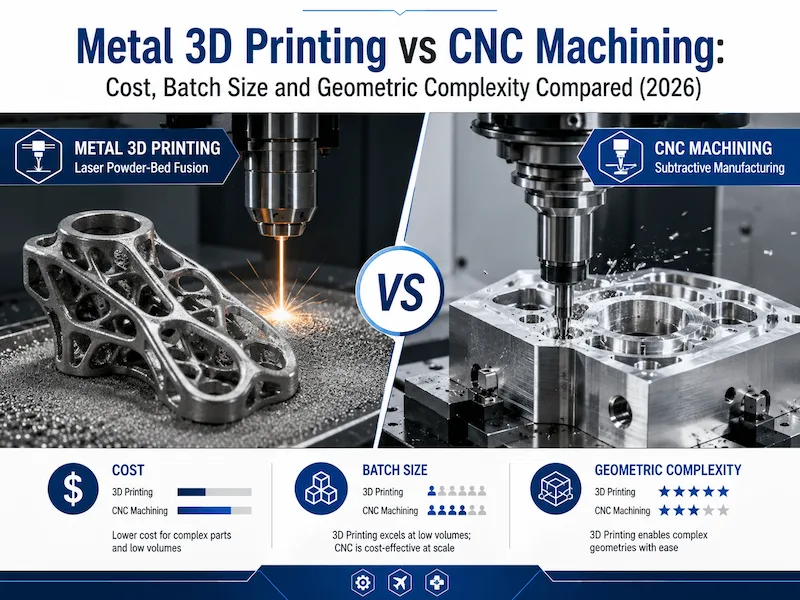
Metal 3D Printing vs CNC Machining: Cost, Batch Size and Geometric Complexity Compared (2026)
Metal 3D printing and CNC machining are not competing technologies — they are complementary processes that win in different operating windows. The...
SLM Metal 3D Printing: The Complete Guide to Selective Laser Melting (2026)
Selective Laser Melting (SLM) is the leading metal additive manufacturing process for producing fully dense, end-use metal parts directly from a CAD...